CHALLENGE

A pin is missing, or bent, and the part has already gone out.

Connectors, headers, needle arrays and terminal strips leave the line with a pin short, a pin bent, or two pins touching. The customer finds it at assembly. The operator counting them by eye finds most of them, which is not the same as all of them.

How it shows up on the line

Customer returns for a short pinA connector with one pin missing fits the housing and fails at the mating end, after shipping.
Bent pins found at the next stationA pin leaning a few degrees passes a visual check and jams in the press or the mating part.
Counting slows the lineAn operator can count a 40-pin header at perhaps one part every few seconds, and not for eight hours.
No recordWhen a batch is questioned there is nothing to show which parts were checked and what was seen.

Why it is still there

The usual fixes have usually been tried.

Eyes tireRepetitive counting is exactly the task people are worst at by the second hour.
Mechanical gauges miss bendsA go/no-go plate catches a missing pin and lets a slightly bent one through.
Rule-based vision breaks on lightingA threshold tuned on Monday fails when the shift changes the lamp or the tray colour.

How DESSAR removes it

Send ten partsA few good parts and every bad one you can find. We image them and show you what separates them.
Fix the viewCamera, lens and light chosen for pin tips against your housing, at your line speed.
Prove it on your rateCount, position and bend on every part, the verdict handed to the machine as OK or NG.
Keep the recordEvery part logged with its image, so a questioned batch has an answer.

The system that removes it

Built as a product, fitted to your part and your line. Open it to run the demo and take the datasheet.
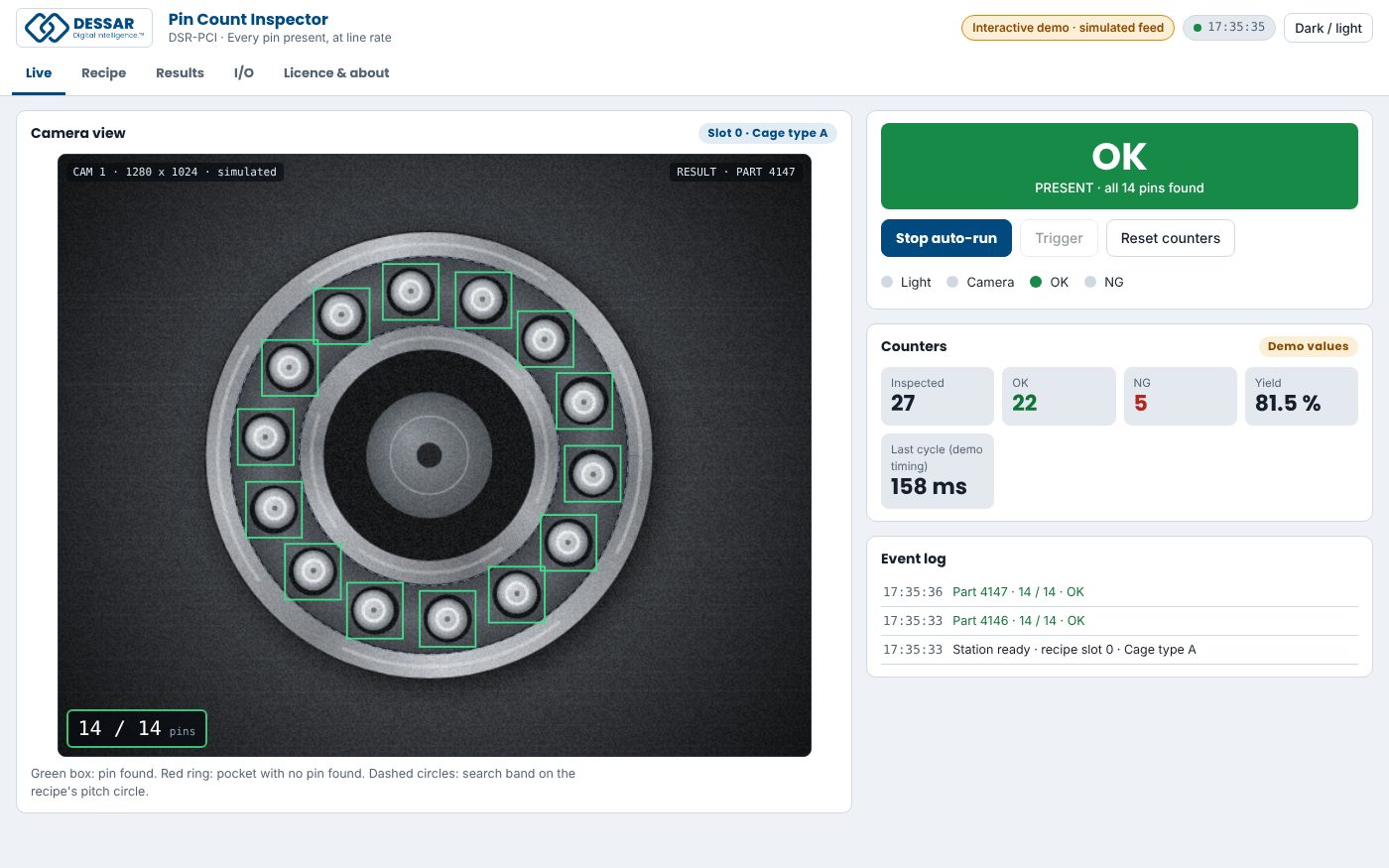
The Pin Count Inspector operator screenPin Count Inspectoroperator screen
DSR-PCI

Pin Count Inspector

Counts pins and needles and proves every one is present, at line rate, with the verdict handed to the machine.

What we need from you to start

A handful of good and rejected parts, the pin pitch, and the rate the line runs at. We come back with what is detectable, at what rate, and what it takes. Sensor selection, capability figures and programme detail are issued against your own application.