CHALLENGE

The terminal block left with one block out of sequence. Nobody saw it.

A DIN-rail assembly carries dozens of blocks, end plates, jumpers and markers. One block in the wrong colour, one marker with the wrong number, one missing end plate, and the panel it goes into is wired wrong. Checking it against the drawing by eye takes minutes, and still misses.

How it shows up on the line

Sequence errors reach the customerTwo blocks swapped look identical from a metre away and are found when the panel is wired.
Markers read wrongPrinted markers are small, grey on white, and read under whatever light the bench has.
Minutes per assemblyA full check against the master takes an operator several minutes per rail, every rail.
Variants multiplyEach customer variant is another drawing to hold in the head while checking.

Why it is still there

The usual fixes have usually been tried.

Checking by drawingComparing a rail to a printed drawing block by block is slow and loses attention halfway.
Barcodes are not thereIndividual blocks carry no code to scan; the identity is in colour, shape and print.
Fixed-rule vision needs a program per variantA new variant means a new program, and the engineer who wrote the last one.

How DESSAR removes it

Teach the masterOne good assembly per variant is captured; the recipe is the master, not a program.
Read everything at onceSequence, block type, colour, the marker text and the end-to-end dimensions in one capture.
Show the differenceEach deviation is marked on the image, so the operator fixes it rather than searches for it.
Keep the proofA record per assembly with its image and the recipe it was checked against.

The system that removes it

Built as a product, fitted to your part and your line. Open it to run the demo and take the datasheet.
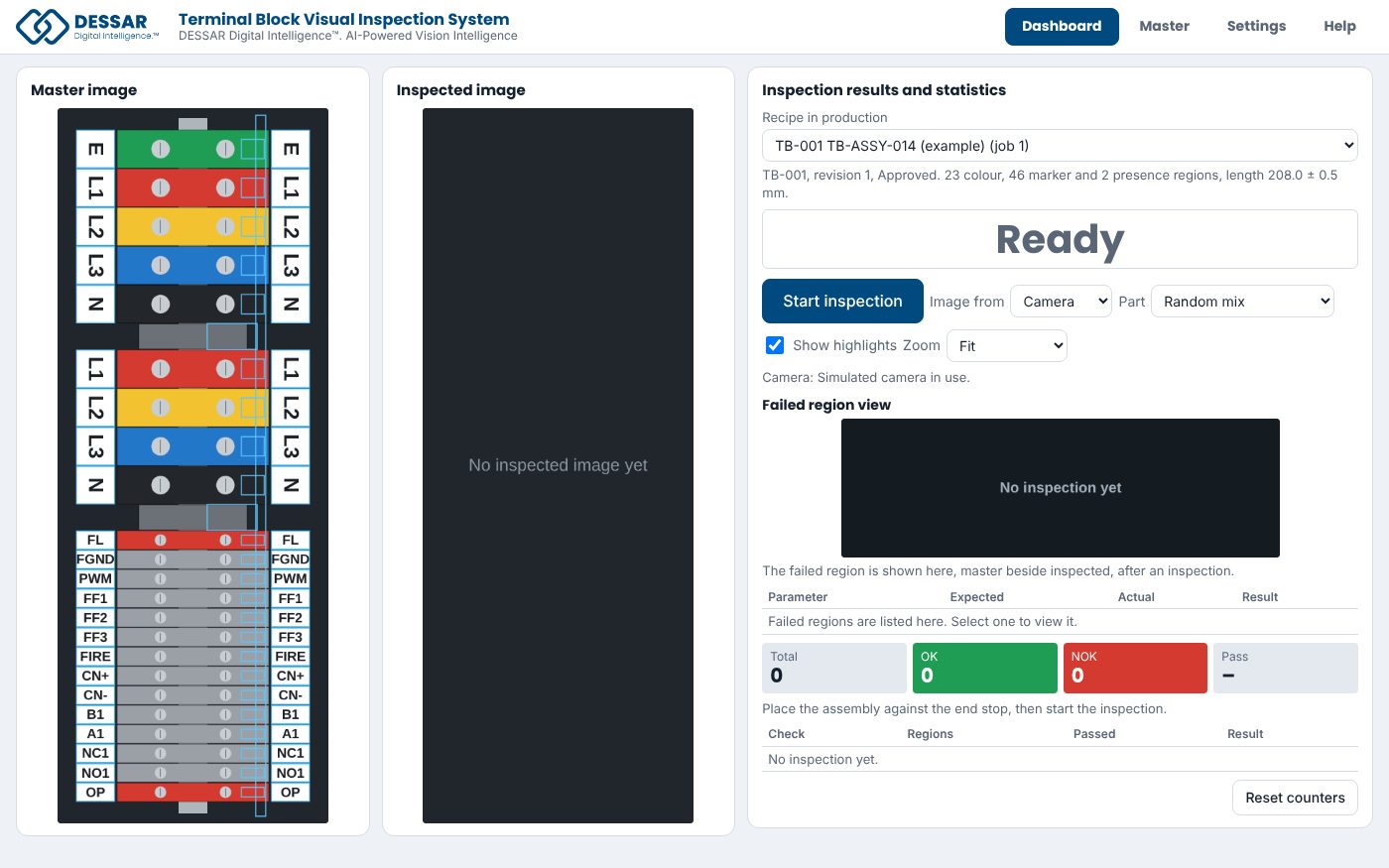
The Terminal Block Inspection operator screenTerminal Block Inspectionoperator screen
DSR-TBV

Terminal Block Inspection

Verifies a DIN-rail terminal assembly against the master: sequence, colour, the markers read by eye, dimensions.

What we need from you to start

Two or three assembled rails per variant, the drawing they are built to, and the marker fonts you use. We come back with what is detectable, at what rate, and what it takes. Sensor selection, capability figures and programme detail are issued against your own application.